Large Scale Mold Manufacturing plays a critical role in producing oversized plastic components for automotive, medical, industrial, and consumer applications. Designing a large plastic part—such as an automotive bumper, an industrial pallet, a logistics container, or a medical equipment housing—is only half the battle. Choosing the correct manufacturing process ultimately determines your upfront tooling investment, per-unit cost, scalability, and final product performance.
Many engineers default to Large Part Injection Molding because of its precision and scalability. However, depending on annual production volume, geometry complexity, and structural requirements, alternative processes such as thermoforming or rotational molding (rotomolding) may offer a more economical solution.
This comprehensive guide compares these three dominant manufacturing processes, breaks down the real costs of Large Scale Mold Manufacturing, and helps you identify the break-even point for your project.
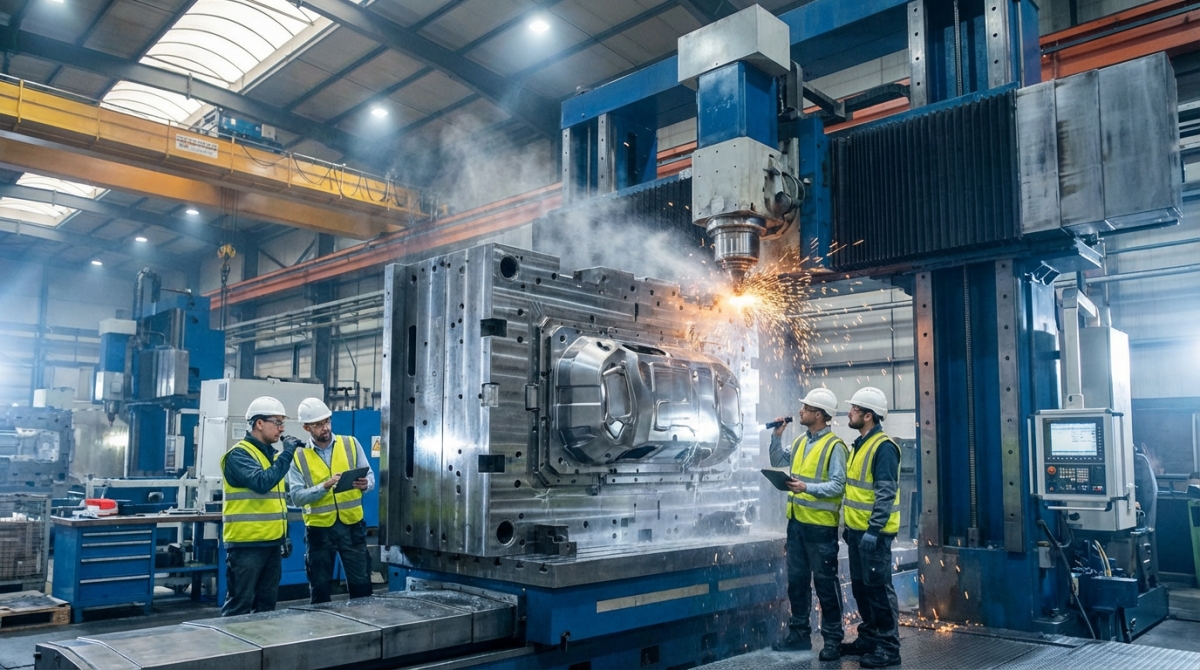
Large Part Injection Molding forces molten plastic resin into a fully enclosed 3D mold cavity under high pressure. The mold defines both sides of the part, enabling precise geometry, tight tolerances, and complex integrated features.
Thermoforming (Vacuum Forming) heats a flat thermoplastic sheet until soft, then draws it over a single-sided mold using vacuum pressure. After cooling, the formed sheet is trimmed into its final shape.
Thermoforming tooling costs are significantly lower. If your expected volume is under 5,000 parts annually, it may be difficult to justify the higher capital investment required for large part injection molding.
Thermoforming molds are often made from cast aluminum or composite materials. Typical tooling costs range from:
$5,000 – $30,000
This is typically the break-even threshold where injection molding becomes more economical than thermoforming due to dramatically lower per-part cost.
Injection molding uses raw resin pellets, which are significantly cheaper than pre-extruded plastic sheets used in thermoforming.
Rotational Molding (Rotomolding) involves placing polymer powder inside a hollow mold that rotates along two axes inside a heated chamber. The material melts and coats the internal surface evenly, creating a hollow part.
Parts have virtually no internal stress and excellent impact resistance.
$3,000 – $20,000
Injection molding is ideal for automotive bumpers, dashboard panels, and industrial enclosures.
| Feature | Large Part Injection Molding | Thermoforming | Rotational Molding |
|---|---|---|---|
| Best Application | High-volume complex panels, pallets, bumpers | Low-volume covers, trays | Large hollow parts, tanks |
| Tooling Cost | $50,000 - $250,000+ | $5,000 - $30,000 | $3,000 - $20,000 |
| Piece Part Cost | Lowest | Medium to High | High |
| Production Speed | 1 - 3 minutes | 5 - 15 minutes | 30 - 60+ minutes |
| Design Complexity | Very High | Low | Medium |
| Ideal Volume | 10,000+ | 500 - 5,000 | 100 - 5,000 |
Large molds require:
$80,000 – $250,000+
Raw resin pellets: $2 – $5 per kg
Machine cost: $150 – $300+ per hour
| Process | Tooling Cost | Unit Cost |
|---|---|---|
| Thermoforming | $10,000 | $50 |
| Injection Molding | $100,000 | $15 |
Break-even ≈ 2,500 units.
Yes. With 3,000T to 5,000T+ injection machines, parts up to 6–8 feet long can be molded.
Thermoforming or polyurethane casting is usually more cost-effective.
Standard resins (PP, ABS, PC) are used, often high-flow or glass-fiber reinforced grades.
Large Scale Mold Manufacturing remains the most powerful solution for high-volume, high-complexity plastic parts. Thermoforming and rotomolding provide cost-effective alternatives for specific geometries and lower volumes, but they cannot match injection molding in scalability, speed, or precision.
Are you trying to decide between thermoforming and injection molding for your next large project?
Send our engineering team your 3D CAD files for a comprehensive DFM and cost-comparison analysis.
With over 20 years of OEM manufacturing experience, HWPD provides product design, prototyping, injection mold making, and full production manufacturing — all in-house with strict intellectual property protection.
Contact us today and turn your large-scale plastic concept into a production-ready reality.